
Canada Cities and Attractions - the world’s 2nd Largest Country by Area
As I write this from my home in Southern California thinking about Canada to me seems almost like the United States. Of course Canadians will almost surely disagree with that. Nevertheless, a trip through this big northern country is just as exciting as traveling through the U.S.
Located in the northern part of the continent, Canada is a North American country consisting of ten provinces and three territories. It extends from the Atlantic to the Pacific and northward into the Arctic Ocean.
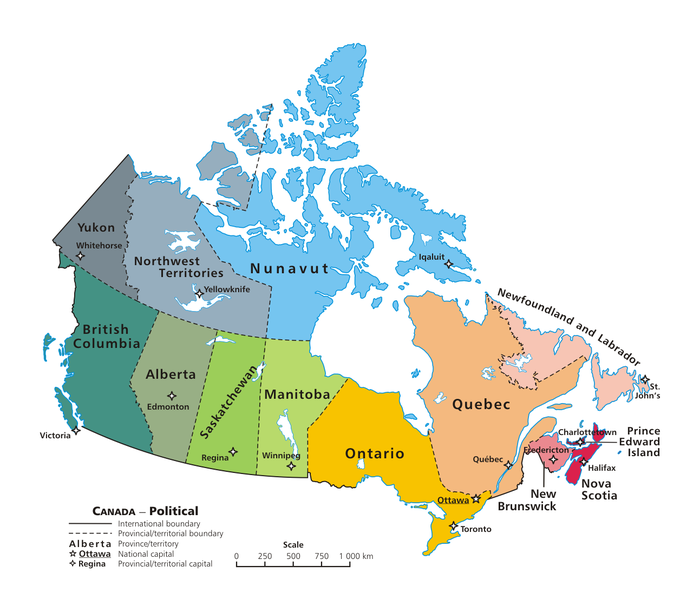
Canada exhibiting its ten provinces and three territories, and their capitals.
Canada is the World’s Second-largest Country
Canada is the world’s second-largest country by total area, and its common border with the United States is the world’s longest land border.

Prime Minister Stephen Harper meeting President of the United States Barack Obama in 2009

Canada’s ice hockey victory at the 2010 Winter Olympics in Vancouver. Photo credit: s.yume
In 1867, with the union of three British North American colonies through Confederation, the country was formed as a federal dominion of four provinces. This began an accretion of provinces and territories culminating in the Canada Act 1982.
This large northern country is a federal state governed as a parliamentary democracy and a constitutional monarchy with Queen Elizabeth II as its head of state.
The country is officially bilingual and multicultural at the federal level, with a population of approximately 35 million as of 2013. Canada’s advanced economy is one of the largest in the world. It relies chiefly upon its abundant natural resources and well-developed trade networks. Networks especially with the United States, with which it has had a long and complex relationship.

Canada as it is Now
Canada is a developed country, with the ninth highest per capita income globally. Canada has the 11th highest ranking in human development. Subsequently, the country ranks among the highest in international measurements of education and government transparency.
Also among highest in civil liberties, quality of life, and economic freedom. It is a recognized middle power and a member of many international institutions.
.jpg)
The Canadarm robotic manipulator in action on Space Shuttle Discovery during the STS-116 mission in 2006. Click image for larger view.
The implementation of official bilingualism of English and French came in 1969. In 2009, the country’s economy suffered in the worldwide Great Recession. Since then it has rebounded modestly.

A Few Stats
According to the 2011 census Canada had a population of 33,476,688 people. Its population density, at 3.3 inhabitants per square kilometer (8.5 /sq mi), is among the lowest in the world.
The Quebec City–Windsor Corridor is the most densely populated and heavily industrialized region of Canada, spanning approximately 1,200 kilometres (750 miles). CC BY-SA 3.0
The Capital is Ottawa. Toronto is the largest city in Canada and the provincial capital of Ontario. Its population as of 2011 was 2,615,060 but about 5 and a half million people live in the Toronto metropolitan area. The population density of the city is 10,750/sq mi.

Something about People
The 2011 Canadian census of about 33 million is an increase of around 5.9 percent over the 2006 figure. Between 1990 and 2008, the population increased by 5.6 million, equivalent to 20.4 percent overall growth. The 2016 census shows a population of 35,151,728. That’s compared to the United States 2017 estimated population right below it of 325,719,178.
The main cause of population growth are immigration and, to a lesser extent, natural growth. About four-fifths of the population lives within 150 kilometers (93 mi) of the United States border. Approximately 80 percent of Canadians live in urban areas.
 They are concentrated in the Quebec City–Windsor Corridor and the British Columbia Lower Mainland. The remaining concentrations are in the Calgary–Edmonton Corridor in Alberta.
In common with many other developed countries, Canada is experiencing a demographic shift towards an older population. There are more retirees and fewer people of working age. In 2006, the average age was 39.5 years; by 2011, it had risen to approximately 39.9 years. As of 2013, the average life expectancy for Canadians is 81 years.
According to the 2006 census, the country’s largest self-reported ethnic origin is Canadian (accounting for 32% of the population), followed by English (21%), French (15.8%), Scottish (15.1%), Irish (13.9%), German (10.2%), Italian (4.6%), Chinese (4.3%), First Nations (4.0%), Ukrainian (3.9%), and Dutch (3.3%). There are 600 recognized First Nations governments or bands, encompassing a total of 1,172,790 people. New immigrants settle mostly in major urban areas like Toronto and Vancouver. Canada also accepts large numbers of refugees. They account for over 10 percent of annual global refugee re-settlements.

Canada has a High Per-capita Immigration Rate
Canada has one of the highest per-capita immigration rates in the world. In 2010, a record 280,636 people immigrated to the country. The Canadian government anticipated between 240,000 and 265,000 new permanent residents in 2012. That is a similar number of immigrants as in recent years.
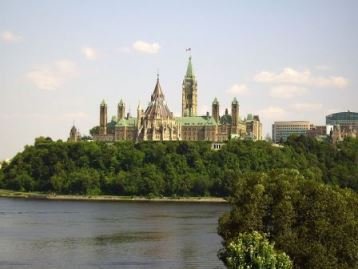
Parliament Hill in Canada’s capital city, Ottawa. Photo credit: Maria Azzurra Mugnai
That is followed by Anglicans (6.8%), Baptists (2.4%), Lutherans (2%), and other Christian denominations (4.4%). About 16.5 percent declare no religious affiliation. The remaining 6.3 percent are affiliated with non-Christian religions. The largest of which are Islam (2.0%) and Judaism (1.1%).

Canada’s Symbols
Canada’s national symbols are influenced by natural, historical, and Aboriginal sources. The use of the maple leaf as a Canadian symbol dates to the early 18th century.
The maple leaf is depicted on Canada’s current and previous flags, on the penny, and on the Arms of Canada. Other prominent symbols include the beaver, Canada Goose, Common Loon, the Crown, the Royal Canadian Mounted Police, and more recently, the totem pole and Inuksuk.

About the Author
Charles is selling most of his valuable domain names. He also reviews PLR Suppliers.
Copyright © Travellistics.com
More about Canada
Canadian Rockies: Banff to Jasper Drive
Banff - Canadian Rockies Mountain Paradise



