
Los Angeles, California; “The City of Angels” or Commonly Known as L.A.
Los Angeles, (Spanish for The Angels), officially the City of Los Angeles, often known by its initials L.A.. It is the most populous city in the U.S. state of California.
It’s the second most populous city in the United States after New York City. The population in 2010 United States Census was 3,792,621.
Los Angeles has an area of 469 square miles, and is located in Southern California.
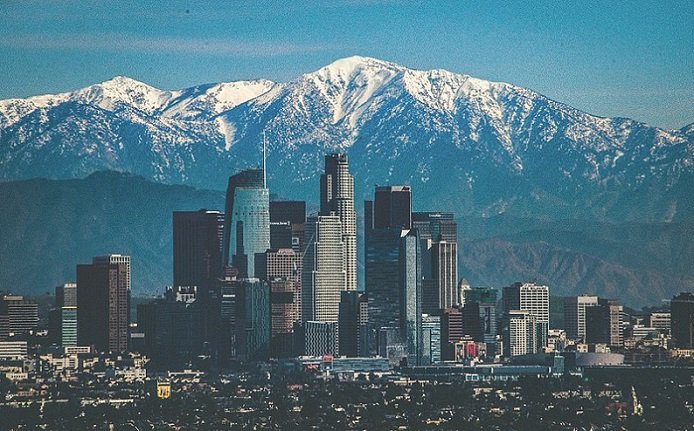
Los Angeles downtown skyline with Mount San Antonio in the background, including Wilshire Grand. Photo by salewskia / CC BY-SA 4.0
LA Area is One of the Most Populous Metropolitan Areas in the World
The city is the focal point of the larger Los Angeles–Long Beach–Santa Ana metropolitan statistical area and Greater Los Angeles Area region. Those areas contain 12,828,837 and nearly 18 million people respectively as of 2010.
That makes it one of the most populous metropolitan areas in the world. It is the second largest in the United States.
L.A. is also the seat of Los Angeles County, the most populated and one of the most ethnically diverse counties in the United States, while the entire L.A. area itself has been recognized as the most diverse of the nation’s largest cities. The city’s inhabitants are sometimes referred to as Angelenos.
20 BEST THINGS TO DO IN LOS ANGELES
by GRRRLTRAVELER | Christine Kaaloa
Published on Youtube on Sep 3, 2014
On my trip to los angeles, I thought I’d do a countdown of my best things to do in los angeles and list of top los angeles hightlights. 20 Things to Do in Los Angeles : Enjoy!
1. Hollywood Blvd 2. El Capitan 3. Kodak Building 4. Walk of Fame/ Star Walk 5. Mann’s Chinese Theater 6. Rock of Fame 7. Hollywood Forever Cemetery (Watch video: 4 Weirdly Cool Museums in L.A.| https://www.youtube.com/watch?v=TfyQK…) 8. Runyon Canyon 9. Hike the Hollywood Sign 10. Canter’s Deli
11. La Brea Tarpits 12. Los Angeles County Museum of Art 8. Free Museum Days 14. Free Live Tapings 15. Eating in L.A. 16. Griffith Observatory 17. The Comedy Store 18. Nightlife L.A. 19 Eating out L.A. 20. Venice Beach
The city was founded on September 4, 1781, by Spanish governor Felipe de Neve. It became a part of Mexico in 1821 following the Mexican War of Independence.
In 1848, at the end of the Mexican–American War, Los Angeles and the rest of California were purchased as part of the Treaty of Guadalupe Hidalgo, thereby becoming part of the United States.
About two years later Los Angeles was incorporated as a municipality on April 4, 1850. Five months later California became a state.

Los Angeles is a Leading World Center in many Fields
Los Angeles is often called the City of Angels, its Nickname. Los Angeles city is a leading world center of business, international trade, entertainment, culture, media, fashion, science, sports, technology, and education.
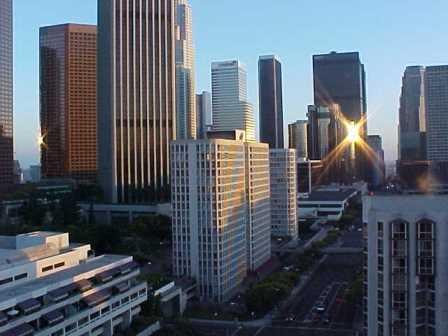
The Financial District of Downtown Los Angeles.: Click image for credits and larger view.
L.A. is home to renowned institutions covering a broad range of professional and cultural fields and is one of the most substantial economic areas in the United States.
The Los Angeles combined statistical area has a gross metropolitan product of $831 billion as of 2008, making it the third largest in the world, after the Greater Tokyo and New York metropolitan areas. As the home base of Hollywood, it leads the world in the creation of television productions, video games, and recorded music. Los Angeles is also one of the leaders in motion picture production.
Back in 1984 Los Angeles hosted the Summer Olympic Games for the second time. The state issued special car license plates (they were optional at a price) for those Olympics which still adorn the wall if my sister’s home.

Los Angeles is Large and Hilly
Los Angeles doesn’t have a regular shape. It has a huge area which covers a total area of 502.7 square miles, almost all of it, 468.7 square miles of land and 34 square miles of water. It is flat and hilly like many of the surrounding cities. The highest point in the city is 5,074 ft (1,547 m) Mount Lukens, located at the northeastern end of the San Fernando Valley.
The eastern end of the Santa Monica Mountains stretches from Downtown to the Pacific Ocean and separates the Los Angeles Basin from the San Fernando Valley. Other hilly parts of L.A. include the Mt. Washington area north of Downtown, eastern parts such as Boyle Heights, the Crenshaw district around the Baldwin Hills, and the San Pedro district.

Earthquakes abound
Los Angeles city is subject to earthquakes due to its location on the Pacific Ring of Fire. The geologic instability has produced numerous faults, which cause approximately 10,000 earthquakes annually. One of the major faults is the San Andreas Fault which is located at the boundary between the Pacific Plate and the North American Plate; it is predicted to be the source of Southern California’s next big earthquake.
 Major earthquakes have hit the Los Angeles area including the 1994 Northridge earthquake, the 1987 Whittier Narrows earthquake, and the 1971 San Fernando earthquake near Sylmar. Regardless of all the earthquakes, all but a few quakes are of very low intensity and are not felt. The Los Angeles basin and metropolitan area are also at risk from certain types of earthquakes.
It is not unusual to have an earthquake in any of the surrounding areas of Los Angles that you can feel maybe two or three times every few years. Parts of L.A. are also vulnerable to tsunamis although damage from them is rare.
Although people from other states make a big deal of earthquakes when they visit LA and surrounding areas, it is something anyone living in Southern California is used to. I have been living in the greater Los Angeles area about seventy miles from the city and remember about maybe ten earthquakes in the last twenty or so years that you could actually feel.
The rest were essentially undetectable unless it occurs right under you or very close to where you live. In spite of all the earthquakes, damage is rare except for the three big ones mentioned above.

Higher Education
Within the city limits there are three public universities; California State University, Los Angeles (CSULA), California State University, Northridge (CSUN) and University of California, Los Angeles (UCLA).
Private colleges in the city include the American Film Institute Conservatory, Alliant International University, Syracuse University (Los Angeles Campus), American InterContinental University, American Jewish University, The American Musical and Dramatic Academy – Los Angeles campus, Antioch University’s Los Angeles campus, Biola University, and the Charles R. Drew University of Medicine and Science.
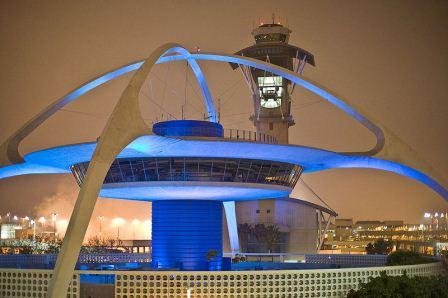
The Theme Building at LAX: Click image for larger view and credits.
There is also National University of California, Occidental College (“Oxy”), Otis College of Art and Design (Otis), Southern California Institute of Architecture (SCI-Arc), Southwestern Law School, and University of Southern California (USC). As you can see there are a lot of colleges in the city. There is no shortage of excellent education here.
The community college system ([2 year] Junior college) consists of nine campuses governed by the trustees of the Los Angeles Community College District: East Los Angeles College (ELAC), Los Angeles City College (LACC), Los Angeles Harbor College, Los Angeles Mission College, Los Angeles Pierce College, Los Angeles Valley College (LAVC), Los Angeles Southwest College, Los Angeles Trade-Technical College and West Los Angeles College.

Freeways
It would be remiss to talk of Los Angeles without mentioning the freeways. Without them it would be most impracticable for most of the millions of people who live in the surrounding areas to work in L.A. They are a lifesaver, but on the other hand cause some of the worst frustration known to man. Case in point, I live about seventy miles from downtown L.A. and if I had to work in the city it could easily take me about three hours to get to work.
In fact, I did work in the city and quit my job there because the company I worked for moved me from a small auxiliary building to their main office on Wilshire Blvd and forced me to keep their regular working hours, which was different from my flexible hours I had had for the previous year.
When I found out I could no longer have flex hours and had to start work at regular hours I promptly quit the job instead of having to fight over two hours each way in traffic on the freeways. Those were at least 4 hours of frustration in stop and go traffic, mostly stop.
Do you have a travel experience to share? CLICK HERE to tell us your story or write a review.
The city and the rest of the Los Angeles metropolitan area are served by an extensive network of freeways and a few highways. The Texas Transportation Institute, which publishes an annual Urban Mobility Report, ranked Los Angeles road traffic as the most congested in the United States in 2005 as measured by annual delay per traveler.

Could this be you earning part-time income blogging from home? Click image to find out.
The Driving time on the Freeways to/from Work is Ridiculous!
The average traveler in Los Angeles experienced 72 hours of traffic delay per year according to the study. This is a big underestimation as far as I am concerned. I used to spend about 1 hour in the morning driving the 55 miles to Irvine Ca. from Lake Elsinore.
But I left at 4:20 am to avoid the heavy traffic. However, coming home I could not miss the traffic unless I waited at least 2 hours before I got on the Freeway. Usually it would take me 3 - 4 hours to drive back home if I left directly from work at 4:15 pm!
Los Angeles was followed by San Francisco/Oakland, Washington, D.C. and Atlanta, (each with 60 hours of delay).
 Despite the congestion in the city, the mean travel time for commuters in Los Angeles is shorter than other major cities, including New York City, Philadelphia and Chicago. Los Angeles’ mean travel time for work commutes in 2006 was 29.2 minutes, similar to those of San Francisco and Washington, D.C.
These statistics, however, don’t reflect the huge number of people who live in the suburbs that drive to LA and experience hours or more of stop and go traffic each way.
Among the major highways that connect LA to the rest of the country and Northern California include Interstate 5, which runs south through San Diego to Tijuana Mexico and north through Sacramento, Portland, and Seattle to the Canadian border; Interstate 10, the southernmost east–west, coast-to-coast Interstate Highway in the United States, going to Jacksonville, Florida; and U.S. Route 101, which heads north to the California Central Coast, San Francisco, the Redwood Empire, and the Oregon and Washington coasts.
Airports
The main Los Angeles airport is Los Angeles International Airport (LAX). It is the sixth busiest commercial airport in the world and the third busiest in the United States.
Other major nearby commercial airports include:
- (ONT) LA/Ontario International Airport owned by the city of Los Angeles; serves the Inland Empire.
- (BUR) Bob Hope Airport, formerly known as Burbank Airport; serves the San Fernando and San Gabriel Valleys
- (LGB) Long Beach Airport, serves the Long Beach/Harbor area
- (SNA) John Wayne Airport of Orange County
One of the world’s busiest general-aviation airports is also located in Los Angeles, Van Nuys Airport (VNY).

Seaports
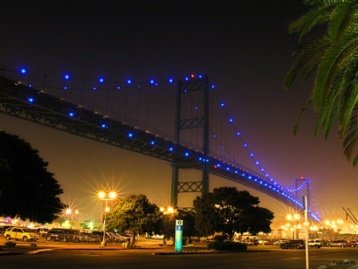
A view of the Vincent Thomas Bridge reaching Terminal Island.: Click image for larger view and credits.
The sea ports of the Port of Los Angeles and Port of Long Beach together make up the Los Angeles/Long Beach Harbor. Together, both ports are the fifth busiest container port in the world, with a trade volume of over 14.2 million TEU’s in 2008. The Port of Los Angeles is the busiest container port in the United States and the largest cruise ship center on the West Coast of the United States.
The port includes four bridges: the Vincent Thomas Bridge, Henry Ford Bridge, Gerald Desmond Bridge, and Commodore Schuyler F. Heim Bridge. There are also smaller, non-industrial harbors along Los Angeles’ coastline. There is also passenger ferry service from San Pedro to the city of Avalon on Santa Catalina Island.

Population
The 2010 United States Census reported that Los Angeles had a population of 3,792,621. The population density was 7,544.6 people per square mile. The Census reported that 3,708,020 people (97.8% of the population) lived in households, 58,186 (1.5%) lived in non-institutionalized group quarters, and 26,415 (0.7%) were institutionalized.
The age distribution was 874,525 people (23.1%) under 18, 434,478 people (11.5%) from 18 to 24, 1,209,367 people (31.9%) from 25 to 44, 877,555 people (23.1%) from 45 to 64, and 396,696 people (10.5%) who were 65 or older. The median age was 34.1 years. For every 100 females there were 99.2 males. For every 100 females age 18 and over, there were 97.6 males.

Population makeup
Los Angeles is home to people from more than 140 countries speaking 224 different languages. There are ethnic enclaves or areas like Chinatown, Historic Filipinotown, Koreatown, Little Armenia, Little Ethiopia, Tehrangeles, Little Tokyo, and Thai Town all of which help makeup the character of L.A.
According to the 2010 Census, the racial makeup of Los Angeles included: 1,888,158 Whites (49.8%), 365,118 African Americans (9.6%), 28,215 Native Americans (0.7%), 426,959 Asians (11.3%), 5,577 Pacific Islanders (0.1%), 902,959 from other races (23.8%), and 175,635 (4.6%) from two or more races. Hispanics or Latinos of any race were 1,838,822 persons (48.5%).
Non-Hispanic whites were 28.7% of the population in 2010. Mexicans make up the largest ethnic group of Latinos at 31.9% of Los Angeles’ population, followed by Salvadorans (6.0%) and Guatemalans (3.6%).
The Latino population is spread throughout the city of Los Angeles and its metropolitan are. However, it is most heavily concentrated in the East L.A. region. That area has a long established Mexican American and Central American community.

Asian Ethnic Groups are also Represented
The largest Asian ethnic groups are Filipinos (3.2%) and Koreans (2.9%), which have their own established ethnic enclaves?Koreatown in the Wilshire Center and Historic Filipinotown.
Chinese people, which make up 1.8% of Los Angeles’ population and reside mostly outside of Los Angeles city limits. A lot of Chinese are in the San Gabriel Valley of eastern Los Angeles County.
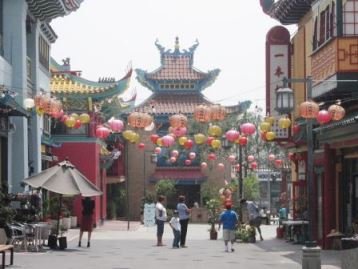
New Chinatown main plaza: Click image for larger view and credits
Chinatown and Thaitown are also home to many Thais and Cambodians. They make up 0.3% and 0.1% of Los Angeles’ population, respectively.
Japanese comprise 0.9% of L.A.’s population, and have an established Little Tokyo in the city’s downtown. Another significant community of Japanese Americans is located in the Sawtelle district of West L.A.
Vietnamese make up 0.5% of Los Angeles’ population. L.A. has a rather small South Asian population. Indians make up 0.9% of the city’s population.
Los Angeles and its large metropolitan area are home to a large Middle Eastern population, including Armenians and Iranians. African Americans have the largest number of people in South Los Angeles. However, since the 1980s, there has been a large influx of immigration from Mexico and Central America.
That has now outnumbered the blacks in South Los Angeles. South L.A., as well as neighboring communities such as the city of Compton that were home to predominant African American populations are now transforming into Hispanic communities.
Have you been here? If so, add your insights below about this interesting travel destination.
Environment
“The valley of smoke” was the name given by the Chumash tribe of Native Americans for the area now known as Los Angeles. Due to its to geography, very heavy reliance on automobiles, and the Los Angeles/Long Beach port complex, Los Angeles suffers from air pollution in the form of smog.
The Los Angeles Basin and the San Fernando Valley are susceptible to atmospheric inversion. That holds in the exhausts from road vehicles, airplanes, locomotives, shipping, manufacturing, and other sources.
 The smog season lasts from May to October. Unlike other large cities that rely on rain to clear smog, L.A. gets only 15 inches of rain each year.
Pollution accumulates over many consecutive days. Issues of air quality in Los Angeles and other major cities led to the passage of early national environmental legislation, including the Clean Air Act.
More recently, the state of California has led the nation in working to limit pollution by mandating low-emission vehicles.
Smog is expected to continue to drop in the coming years due to aggressive steps to reduce it. These steps include electric and hybrid cars and improvements in mass transportation.
The number of Stage 1 smog alerts in L.A. has declined from over 100 per year in the 1970s to almost zero since 2000.
 Despite this improvement, the 2006 and 2007 annual reports of the American Lung Association ranked the city as the most polluted in the country, That’s because of short-term particle pollution and year-round particle pollution.
In 2008, Los Angeles was ranked the second most polluted and again had the highest year-round particulate pollution. The city met its goal of providing 20 percent of the city’s power from renewable sources in 2010.
Depending on which suburb one lives in outside of LA, the smog can be worse than in LA. For example I live in the Inland Empire region of Southern California.
During the 30+ years I’ve lived here the air pollution has gotten far worse over the years.
As an estimate I would say the air pollution is such that now possibly 85% of the days there is noticeable air pollution. That’s compared to when I first moved here when it was the opposite. I estimate 15% of the time noticeable pollution and 85% of the time the air appeared clean.

Crime in Los Angeles
Los Angeles has been experiencing significant decline in crime since the mid-1990s like most American cities. It reached a 50-year low in 2009 with 314 homicides.
This is a rate of 7.85 per 100,000 population, a major decrease from 1993. That was when the all-time high homicide rate of over 21.1 per 100,000 was reported for the year.
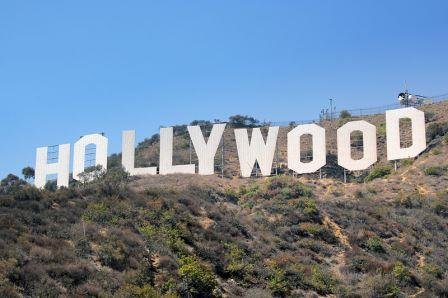
Hollywood Sign: Click image for larger view and credits
Among them are the Crips and Bloods, which are both African American street gangs that originated in South L.A.
Latino street gangs such as the Sureños, a Mexican American street gang. Also Mara Salvatrucha, which has mainly members of Salvadoran descent, all originated in L.A. The 18th Street has a predominately Latino membership but is multiethnic.
This heavy gang population has led to the city being referred to as the “Gang Capital of America”.

Living in Downtown Los Angeles or elsewhere in LA
If a person were working in or near downtown Los Angeles (LA) they might consider living there. It would have great benefits aside from being close to work. Unfortunately for most people that would be out of the question. Why? Well unless one was making in the high six-figure salary range or higher, the cost would be prohibitive. That eliminates most people and families.
Pros and Cons of Living in Los Angeles
by Fresh Pepper
Published on Youtube on Jun 22, 2017
A few pros and cons of living in LA
Actually the high cost of almost all homes in Los Angeles or close by are way higher than many other places in the USA. That’s why myself and millions of other people moved to the suburbs. Cost of homes are lower outside of Los Angeles County. Sometimes much lower than homes closer to LA.
Could you afford well over $500,000 to buy a home in Los Angeles?

Copyright © Travellistics.com
About the Author
Charles sells domain names and is also delving into superstitions.
Los Angeles & Poverty

